Compound interest means you earn interest on your interest. When a bank credits interest to your savings, that interest joins your balance, and the next round of interest is calculated on the new, larger total. Repeated over years, the process bends your balance into an accelerating curve instead of a straight line, and it's the main reason starting to save early beats saving more later.
How does compound interest work?
Picture a $10,000 balance earning 5% a year. Simple interest would pay $500 every year, forever; the interest never joins the principal. Compounding changes the base: after year one you have $10,500, so year two's 5% is calculated on $10,500 and pays $525. Year three pays on $11,025. Each year's interest is slightly larger than the last, with no extra effort from you.
The standard formula for a lump sum is:
A = P × (1 + r/n)^(n×t)
where P is your starting amount, r the annual rate as a decimal, n how many times per year interest compounds, and t the number of years. Most savings accounts compound daily or monthly and credit the interest monthly.
That formula is also why quoted "interest rates" and APY differ slightly: APY folds the compounding in, which is exactly why regulators standardized on it for comparing accounts. Our APY vs. interest rate guide unpacks that distinction.
What compounding looks like over 30 years
Formulas undersell it; the curve makes the point. Here's a saver who starts with $5,000 and adds $100 every month at a constant 5% annual rate, compounded monthly:
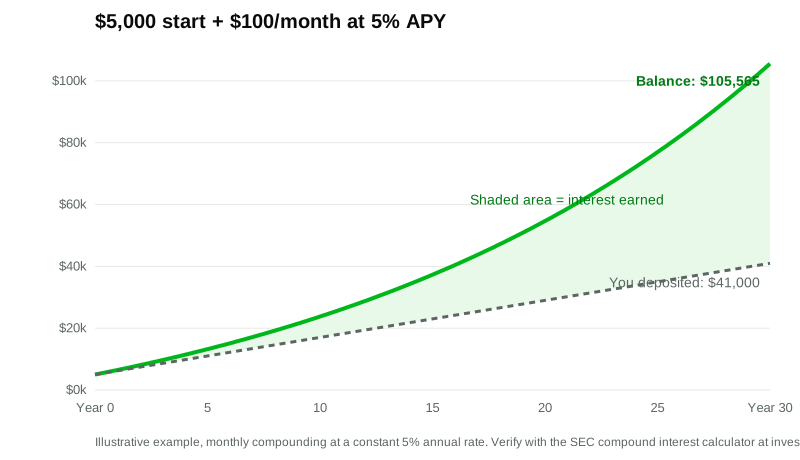
Three decades in, the account holds about $105,565, but only $41,000 of it was ever deposited. The remaining ~$64,000 is interest, most of it earned in the later years when the balance was largest. That back-loading is the signature of compounding: the last five years of the chart generate more interest than the first fifteen.
You can test any scenario yourself with the SEC's compound interest calculator at investor.gov, an official, ad-free tool that handles monthly contributions and different compounding frequencies.
Why starting early beats saving more
Because time is the exponent in the formula, not a multiplier. A saver who starts at 25 and stops contributing at 35 can end up ahead of one who starts at 35 and contributes until 65, given the same rate; the first decade of growth keeps compounding for thirty more years. The practical translation: the best day to move your savings somewhere that pays a real rate is the day you have savings, even if the amount feels small.
Compounding also runs in reverse. Credit card balances compound against you at rates several times what any savings account pays, which is why paying down high-interest debt is usually the better "investment," a theme we cover in signs you're overpaying for financial services.
Two fine-print facts about savings interest
- It's taxable. Interest credited to your account is taxable income in the year you can withdraw it. Your bank sends Form 1099-INT once interest reaches $10, and the IRS requires you to report interest even below that threshold.
- Rates float. Savings APYs move with the broader rate environment, so long-term projections at any fixed rate are illustrations, not promises. The compounding math holds at whatever rate applies.
Frequently Asked Questions
- What is compound interest in simple terms?
- It's interest earned on interest. Each time your bank credits interest, it becomes part of your balance, and future interest is calculated on that larger amount, so growth accelerates over time instead of staying flat.
- What's the difference between compound interest and simple interest?
- Simple interest is always calculated on your original deposit only, so it pays the same amount every period. Compound interest is calculated on your deposit plus accumulated interest, so payments grow. Over long periods the difference is dramatic.
- How often do savings accounts compound interest?
- Most compound daily or monthly and credit interest to the account monthly. The exact schedule matters less than the APY, which already reflects compounding frequency and is the number banks must disclose for comparison.
- Do I pay taxes on compound interest from savings?
- Yes. Savings interest is taxable income in the year it's credited and withdrawable. Banks issue Form 1099-INT when your interest reaches $10 for the year, and the IRS requires reporting interest income even without a form.
- How long does it take money to double with compound interest?
- A quick estimate is the Rule of 72: divide 72 by the annual rate. At 4%, money doubles in roughly 18 years; at 6%, about 12 years. It's an approximation, but a useful one for comparing scenarios.